By Dr Oliver Hulson, Consultant Radiologist, and Bahram Hassanpourfard, Epidemiologist
Ultrasound roundup · October 2026
Ultrasound is having one of its busiest years in a long while. Three themes stand out from the past few months. AI guidance now allows clinicians with no sonography training to capture scans of diagnostic quality. The large imaging companies have launched a wave of new systems. And therapeutic ultrasound, histotripsy above all, is turning into a serious commercial business.
The major vendors refresh their ranges
GE HealthCare used the ESC Congress in Munich, held from 28 to 31 August, to launch three cardiovascular systems: Vivid Explorer, Vivid Advanced and Vivid Focus1. All three are built on its cSound imaging platform and include AI tools to support workflow. They carry the CE mark, while US 510(k) clearance is still pending. Philips followed on 3 September with the eV14-2v transvaginal transducer, which has both FDA clearance and the CE mark2. The company says it gives 41.7% more penetration and 10% better 2D resolution while weighing 22% less. On 7 September Samsung Medison launched the HERA Z10, a second premium system for obstetrics and gynaecology alongside the HERA Z203. In a study at Sapienza University, its Live ViewAssist tool cut the time needed for detailed second trimester scans by up to 52%.
AI puts the probe in more hands
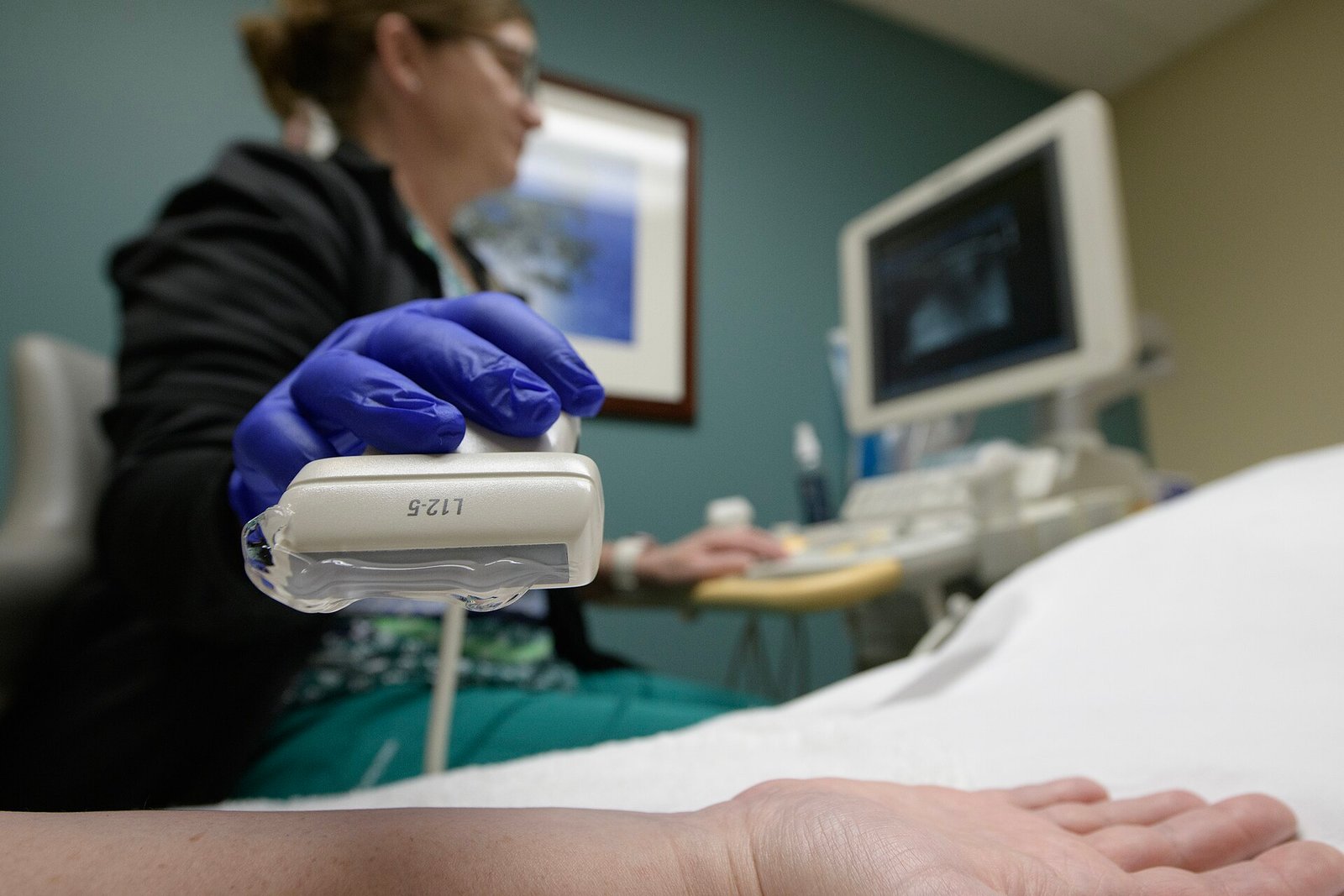
Software that coaches the person holding the probe has been the busiest area for regulatory clearances. In late July ThinkSono received FDA 510(k) clearance for AI guidance that allows staff with no ultrasound training to capture compression scans for deep vein thrombosis on Clarius handheld scanners, after 60 to 90 minutes of training4. In early August RadNet’s DeepHealth was cleared for software that uses AI to automate breast ultrasound5. Earlier in the year, an AI tool from UNC and Butterfly Network was cleared that estimates gestational age from “blind sweep” scans taken by untrained operators, with settings that have limited resources in mind6. On 23 September UltraSight raised $24m in a Series B2 round to bring Echosystem, its cardiac guidance software already cleared by the FDA, to more US health systems7. If these tools perform in routine practice as they did in validation, the limiting factor shifts from who can acquire a scan to who can read it and act on it.
Butterfly’s chip finds a new market
Butterfly Network reported record revenue of $32.6m for the second quarter, up 39% on the same period last year, with gross margin rising to 71.4%8. US revenue grew 57%, driven by Butterfly Embedded, its licensing business. That business has since signed its most striking deal yet9. A multiyear licence gives Merge Labs access to Butterfly’s Poseidon family of ultrasound chips, to be used in brain computer interfaces that work through ultrasound. Merge Labs, the brain computer interface startup cofounded by Sam Altman, launched in January with $252m in seed funding. Butterfly becomes its exclusive partner for ultrasound on a chip and will receive upfront, milestone and hardware payments, as well as royalties on any future sales.
Histotripsy comes of age
HistoSonics makes the Edison system, which uses focused ultrasound to destroy tumours mechanically, without incision, radiation or heat. In June it closed a financing round that valued the company at $3.75bn, with Reed Jobs and Yosemite among the investors10. In May it asked the FDA, through a De Novo request, to extend Edison from liver tumours to kidney tumours, supported by the #HOPE4KIDNEY trial of 67 patients11. It has also treated its first patients with benign prostatic hyperplasia, gained approval in Taiwan and been named one of Time’s ten most influential health and life science companies of 2026.
What to watch
The FDA’s decision on histotripsy for kidney tumours would be the first extension of the technique beyond the liver. Other milestones to watch are US clearance of GE HealthCare’s new Vivid systems, Butterfly’s pending FedRAMP certification, which would open sales across US federal health services, and the US rollout of Pulsenmore’s prenatal scanner for use at home. That scanner is the first ultrasound device the FDA has authorised for patients to use themselves12.
References: 1. GE HealthCare (Vivid systems, ESC Congress 2026) · 2. Philips (eV14-2v, 3 September 2026) · 3. Korea Biomedical Review (Samsung Medison HERA Z10, 7 September 2026) · 4. HIT Consultant (ThinkSono, 29 July 2026) · 5. HIT Consultant (DeepHealth, 3 August 2026) · 6. UNC Gillings School of Global Public Health (gestational age AI) · 7. HIT Consultant (UltraSight, 23 September 2026) · 8. Butterfly Network second quarter 2026 results (30 July 2026) · 9. MobiHealthNews and Digital Health News (Butterfly and Merge Labs) · 10. HistoSonics (financing, 22 June 2026) · 11. MedTech Dive (kidney De Novo submission) · 12. AuntMinnie (Pulsenmore De Novo)